
Push-in fittings are fast. Cut the tube cleanly, insert it to depth, and the collet grabs. No thread tape, no spanners, no fuss. For clean plant pneumatics, control circuits, and fixed routing where vibration is low and access is good, they are a practical and reliable choice.
Threaded fittings take longer to install but offer a more mechanically robust connection. Where lines vibrate, move with equipment, or sit in hard-duty environments, a threaded joint tends to hold up better over time.
Here is where each type fits best:
| Push-in fittings | Threaded fittings | |
|---|---|---|
| Best for | Fixed plant, control circuits, clean environments | Mobile plant, heavy equipment, high-vibration lines |
| Install speed | Fast, tool-free | Fast, tool-free |
| Serviceability | Easy to swap on the spot | Harder to change but rarely needs it |
| Vibration tolerance | Limited, especially with side load | Higher, more structural integrity |
| Common failure mode | Collet wear, partial blow-off, slow leak | Overtightening, wrong thread type, poor seal |
| Typical industries | Packaging, automation, food processing | Transport, mining support, heavy fabrication |
A push-in fitting relies on a few things going right at once: correct tube OD, a clean square cut, full insertion depth, and a line that stays put. When those conditions hold, the fitting works well and keeps working.
The trouble starts when the line moves.
Hose that flexes, gets dragged, cops side load at the fitting, or runs through areas with constant vibration will stress the collet over time. The seal degrades. Air starts weeping. Someone tightens the hose, pushes it back in, maybe wraps some tape around it. The leak comes back a fortnight later.
This is the pattern behind most repeat callouts on push-in connections. The fitting itself is not faulty. It is just not matched to the duty.
Threaded connections earn their keep where reliability matters more than speed of changeout. A pneumatic line feeding a critical actuator on mobile plant, or a supply line running through a high-vibration zone on a press, needs a connection that will not walk loose over thousands of cycles.
That said, threaded fittings are not idiot-proof either. Common mistakes include:
Most leaks are not bad luck. They are built into the assembly before the line gets pressurised.
Air leaks are easy to live with because they are easy to ignore. A fitting weeps a little. The regulator gets bumped up a notch. The compressor runs a bit longer. Nobody shuts down a line over a slow leak.
But leaks accumulate. Pressure drop creeps up. Cylinders lose response. Tools feel sluggish. Operators wind the pressure higher to compensate. The compressor works harder to support a system that has quietly become less efficient than anyone realises.
At that point, the cost is not the $4 fitting. It is the energy, the lost cycle time, and the maintenance hours chasing symptoms instead of causes.
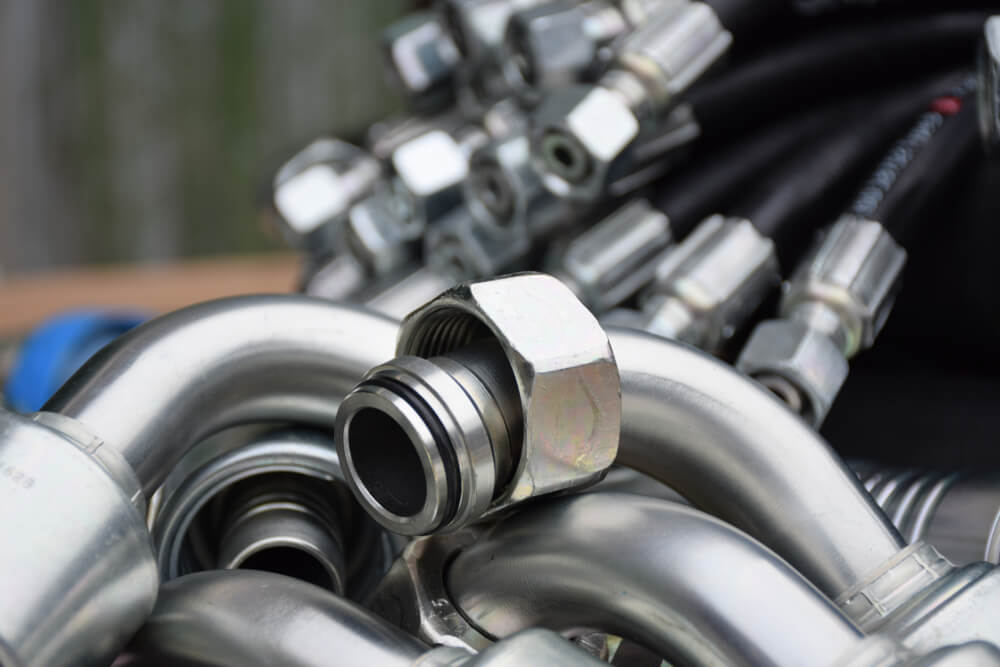
Skip the catalogue and start at the connection point. Five questions sort out most decisions:
Ace Hoses supplies and fits pneumatic hose systems across Melbourne’s northern industrial corridor, with push-in fittings, threaded connections, quick-connect couplers, and custom cut-to-length assemblies on hand. The service covers hose supply and installation, leak detection and repair, fitting and valve supply, and replacement of worn pneumatic lines.
For sites dealing with repeat leaks or unreliable air lines, the fix is usually to reassess the whole hose-and-fitting assembly rather than swapping the same part again. Component selection based on actual site conditions, not just thread size, is where the difference shows up.